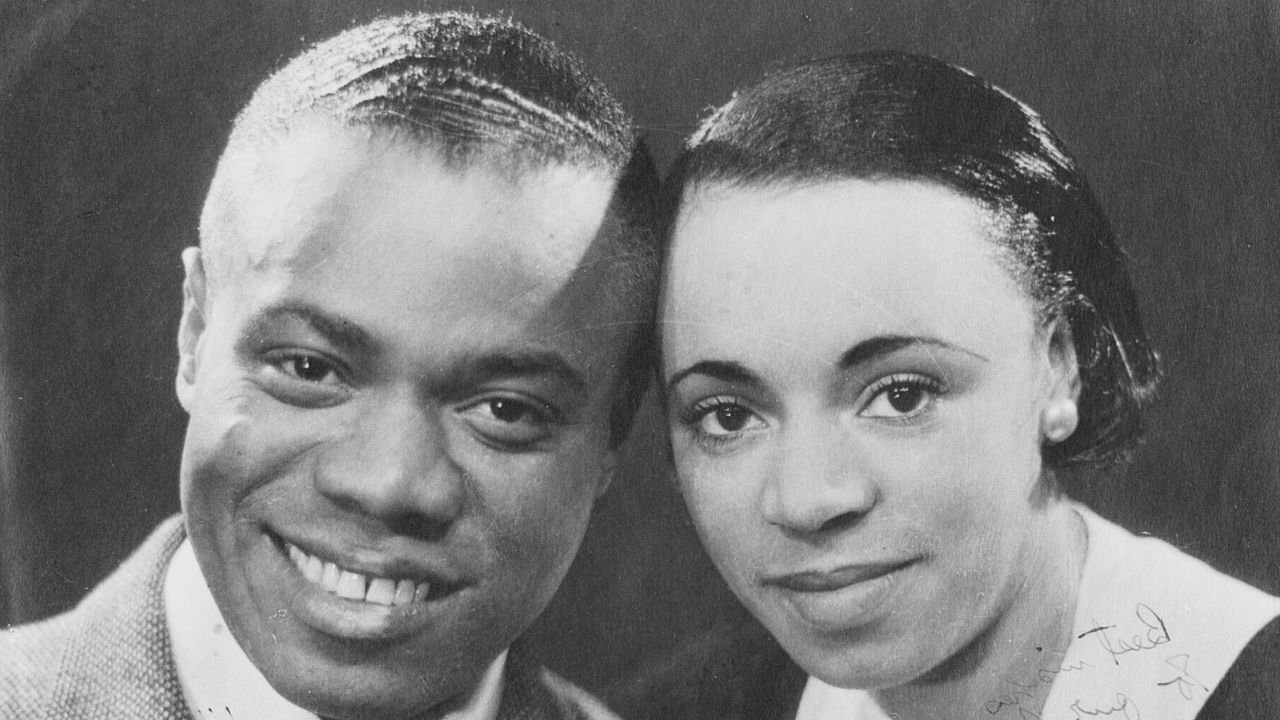
Most people who search for “Alpha Smith” are looking for a name that appears quietly in Louis Armstrong’s biography. She wasn’t a performer or a public figure in her own right. But she was present during some of the most important years of Armstrong’s career — and she left behind at least one remarkable artifact: a scrapbook.
This article covers who Alpha Smith was, where she came from, how she entered Armstrong’s world, what her life looked like during their years together, and what happened after their divorce in 1942.
Who Was Alpha Smith?
Alpha Smith was Louis Armstrong’s second wife. After their marriage was formally recorded in 1938, she appeared in documents as Alpha Armstrong or Mrs. Louis Armstrong. Before that, she had already been using his name informally for years.
She is not a celebrity in her own right. Her historical significance comes almost entirely from her connection to Armstrong and the personal records she kept during their time together. She was born around 1906 or 1907 and died in January 1960.
One important note: several unrelated women named Alpha Smith appear in genealogical databases. There is an Alpha Smith who married a man named Nimrod Anderson, and another Alpha Smith who later took the surname Meyer. This article focuses specifically on the Alpha Smith who married Louis Armstrong — a distinct individual with her own documented life story.
Her Family Background and Early Life
Alpha’s exact birthplace is one of those small historical puzzles that genealogists encounter often. Her death certificate lists Illinois as her place of birth. But multiple census records consistently point to Indiana. Historians note the discrepancy without fully resolving it — this kind of conflict between vital records and census entries is common, especially for African-American families who moved frequently in the early twentieth century.
Her mother, Florence Smith, was a divorced woman who worked as a pantry girl at a Chicago hotel. By the 1920 census, Florence and Alpha were living together in Chicago. Alpha was around thirteen at the time.
Her father, Wirt Smith, is a more notable figure in local history. He has been described as a pioneering Black pharmacist — one of the first in his city. By the time Armstrong married Alpha in 1938, press accounts referred to Wirt as Armstrong’s father-in-law. His relationship with Florence had been complicated; the two had separated, and Wirt’s own later records show some inconsistencies in how he described his marital history. But his professional standing gives a sense of the world Alpha came from — a family that included both hardship and achievement.
Alpha completed at least one year of high school before entering the workforce. The records don’t go into further detail about her early education or teenage years beyond that.
Alpha Smith in Chicago’s Jazz Scene
As a young woman in Chicago during the 1920s, Alpha worked as a dancer. She was active in the city’s jazz scene at exactly the moment when that scene was transforming American music.
Louis Armstrong had moved to Chicago from New Orleans and was already making a name for himself as a cornet player. The overlap between Alpha’s world — nightlife, dance, music venues — and Armstrong’s rising career is what brought them together. It wasn’t a chance meeting outside their usual environments. They existed in the same orbit.
Alpha began appearing alongside Armstrong sporadically from around 1926. By the early 1930s, she was with him more consistently. What makes this period especially interesting is what she did with her proximity to that world: she kept a scrapbook.
The scrapbook, which covers 1926 to 1931, documents Armstrong’s performances and career moments through clippings, photographs, and other materials. It’s a physical record of her closeness to a pivotal period in jazz history. The Louis Armstrong House Museum has built a virtual exhibit around it, titled “Louie (My Darling) ZING,” which offers a genuine window into both Armstrong’s early career and Alpha’s role as an attentive, engaged presence in his life.
Marriage to Louis Armstrong and Life as Mrs. Armstrong
Even before the marriage was legal, Alpha had already begun signing herself alongside Armstrong’s name. She wrote “Alpha Armstrong” in personal records well before 1938, which says something about how she understood her place in his life during those years.
Their marriage was formally recorded in 1938. By that point, Armstrong was widely recognized across the country as a major trumpet player and bandleader. His Chicago years in the 1920s had helped shift jazz from dance-hall music into something taken seriously as an art form. By the late 1930s, he had national and international recognition.
The 1940 census places Alpha and Louis together in the same household, reflecting a stable domestic arrangement during that period. Her role was largely behind the scenes. She maintained scrapbooks, traveled with Armstrong, and was present during tours and performances — but she held no public-facing position and sought no spotlight of her own.
Armstrong’s first wife had been Daisy Parker. Alpha was his second. He would go on to marry two more times after Alpha, with his fourth wife, Lucille Wilson, being the one most often mentioned in standard biographies. But Alpha’s years with Armstrong — spanning roughly from the early 1930s through 1942 — covered some of his most creatively and professionally significant time.
The 1942 Divorce and Life Afterward
Alpha and Louis Armstrong divorced in 1942. The records don’t explain the reasons in detail, and it would be speculation to suggest any particular cause. What is clear is that after the divorce, Alpha largely disappeared from public record.
There are no press mentions, no public appearances, and no documented professional activity in the years that followed. She apparently never remarried. She lived in the Los Angeles area, at one point residing on Roxbury Drive in Beverly Hills — a street that also happened to be home to notable figures like Lucille Ball, Jimmy Stewart, and Jack Benny. That address speaks to her economic circumstances, but there is no evidence of close social ties to those neighbors or involvement in Hollywood life.
For anyone tracing her story through genealogical records, this gap between 1942 and 1960 is simply empty. The next documented moment in her public record is her obituary.
Alpha Smith died in January 1960 at approximately age 53, following a short illness. She was buried at Woodlawn Cemetery in Los Angeles.
Why Her Name Still Surfaces in Research
Alpha Smith comes up in genealogical databases and Armstrong-related research for a few connected reasons. Platforms like Ancestry and MyHeritage include her in family trees attached to Louis Armstrong’s profile. Because she appears under two different surnames — Smith before marriage, Armstrong after — researchers sometimes encounter her without initially realizing they’re looking at the same person.
This is a very common genealogy problem. A woman might appear as Alpha Smith in a 1920 census record, then surface as Alpha Armstrong in a 1940 census, and finally as “Alpha, widow” in a later document with no surname listed at all. Cross-referencing those entries with dates, locations, and connected names is how historians piece together a coherent picture.
The scrapbook has also renewed interest in her story. The Louis Armstrong House Museum’s virtual exhibit introduced her to an audience that might never have come across her name otherwise. That kind of archival project has a way of pulling overlooked figures back into the conversation.
For those interested in African-American social history, Alpha’s trajectory is worth noting on its own terms. She moved from a modest Chicago household — her mother working as a hotel pantry girl — to a Beverly Hills address by the end of her life. Her father, despite a complicated personal history, left a mark as a professional pioneer. These details place Alpha within a broader story about Black middle-class life in twentieth-century America, one that doesn’t get told as often as it should.
If you’re researching figures connected to jazz history or African-American genealogy, resources like Daily Business Goal can help you find tools and guides for organizing your research process effectively.
A Quiet Presence in a Loud Story
Alpha Smith was not famous. She didn’t perform on stage or give interviews or appear on record labels. But she was there — through Armstrong’s Chicago years, through his rise to national recognition, through the years when jazz was becoming something the whole world would eventually claim as its own.
Her scrapbook is a quiet kind of testimony. It says she was paying attention. She saved things, documented moments, and kept a record of a life she was living alongside one of the most significant musicians of the twentieth century.
That she spent the last eighteen years of her life largely out of view doesn’t diminish what came before. It just means her story has to be found the way many overlooked stories are found — in census pages, old obituaries, and the careful work of people willing to look.
Also Read:

